Watch
From idea to prompt in 15 seconds
Type a slash, pick a command, choose your tool, copy.
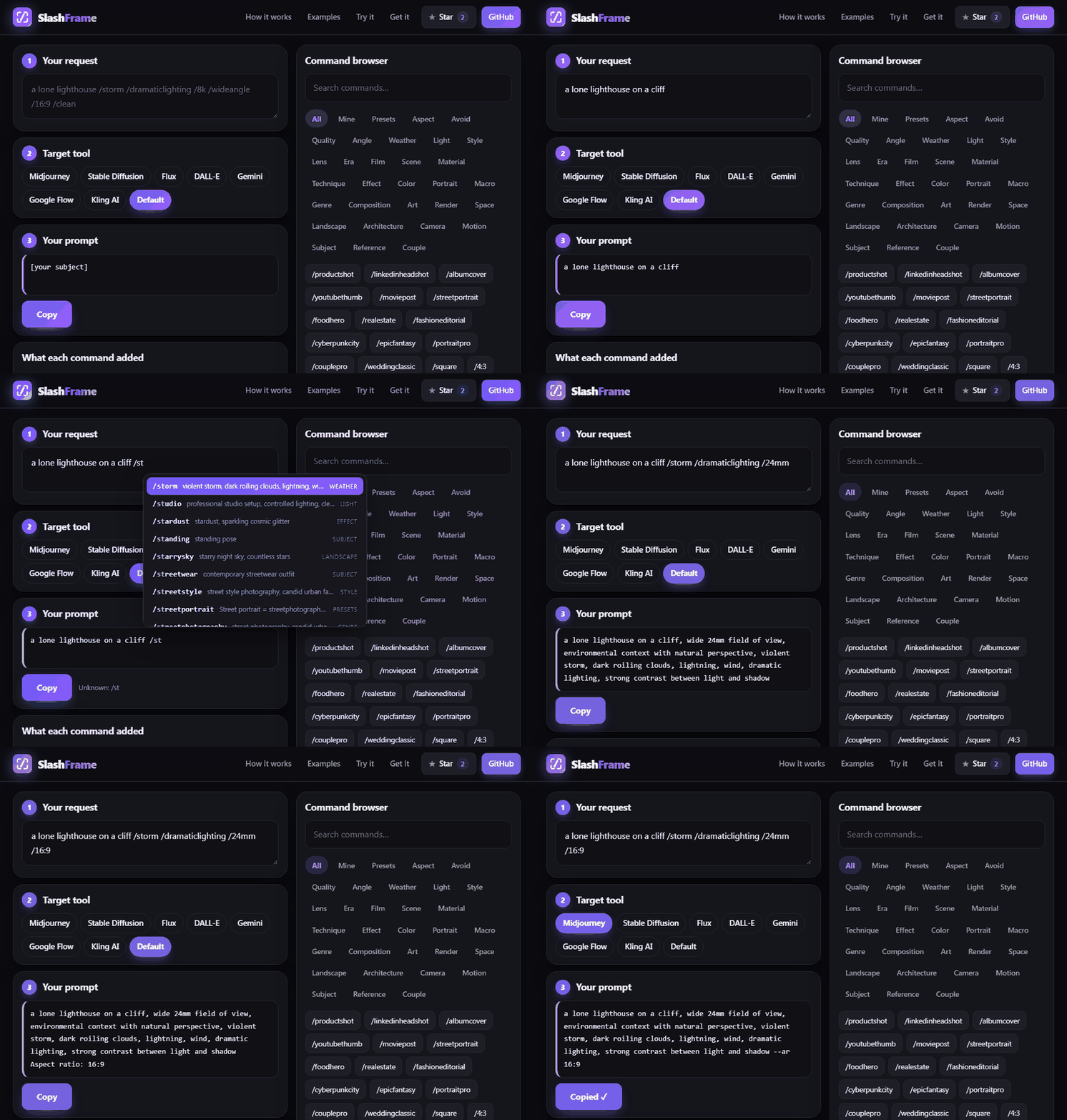
Type your idea and a few slash commands. SlashFrame writes a Midjourney-style prompt (comma-separated phrases) and adds the --ar aspect ratio and a --no list at the end. Free, runs in your browser, no sign-up.
You type
You get (Midjourney format)
How it works
You keep control of the idea. The commands add the camera, light and style wording that image tools respond to.
Say what you want, then add commands such as /goldenhour or /85mm. Plain words like "cinematic" work too.
Midjourney, Stable Diffusion, Flux, DALL-E, Gemini, Google Flow or Kling. The prompt is formatted the way that tool likes it.
One click copies the finished prompt, plus a negative prompt when your tool has one. A list shows what every command added.
Watch
Type a slash, pick a command, choose your tool, copy.
Examples
Drag the slider. The left side is the plain idea, the right side adds commands.
Try it
Everything below runs in your browser. Click commands on the right to add them.
Free prompt generators
Each tool wants a slightly different format. Pick yours and get the right one.
New to prompts? Read how to write AI image prompts, or browse the command cheat sheet.
Get it
The same commands work as a Claude skill and plugin, a ChatGPT GPT, a Gemini Gem, this web page, and ComfyUI nodes.
Install the plugin in two commands. (Its id is still image-style.)
claude plugin marketplace add geevarghesekthomas84-sys/image-style-skill
claude plugin install image-style@image-style-market
Prompt, upload and SVG nodes, plus ready workflows. Unzip into custom_nodes and restart.
ComfyUI-ImageStyle.zip
Ready-made files for a Custom GPT, a Gemini Gem and a Claude.ai skill upload. Steps are in the README.
dist/platforms/
At most 8 style modifiers, and when two commands clash the later one wins.
Every command is listed with the exact words it added, so you can learn what each does.
Save a set of commands as your own recipe, or copy a link that opens your exact request.
MIT licensed. Everything is on GitHub.
About
Midjourney prompts are read as a list of descriptive phrases, with the subject first and the details after it. Settings such as the aspect ratio (--ar 16:9) and things to leave out (--no text, watermark) go at the end of the prompt.
SlashFrame builds exactly that. A command like /goldenhour becomes the phrase "golden hour, warm low-angle sunlight, long soft shadows", a ratio command such as /16:9 becomes --ar 16:9, and an avoid-list such as /clean becomes a --no list.
Using /sameface or /samestyle adds the placeholders --cref [face image URL] and --sref [style image URL], so you only paste your own image links.
You type:
a lone lighthouse on a cliff /storm /dramaticlighting /24mm /16:9 /clean
You get:
a lone lighthouse on a cliff, wide 24mm field of view, environmental context with natural perspective, violent storm, dark roiling clouds, lightning, wind, dramatic lighting, strong contrast between light and shadow --ar 16:9 --no text, watermark, logo, signature, caption, username
Want a different tool? See all free prompt generators.
FAQ
Short answers about SlashFrame, the free AI image prompt generator.
Yes. Add a ratio command like /16:9 or /9:16 and the prompt ends with the matching --ar value. If you ask for several ratios, you get one prompt per ratio.
Use an avoid command such as /clean, /nopeople or /notext. SlashFrame writes the matching words after --no.
Yes. It is free and open source under the MIT license. There is no account, no sign-up and nothing to install to use the website.
It formats prompts for Midjourney, Stable Diffusion, Flux, DALL-E and ChatGPT, Gemini, Google Flow and Kling. It also ships as a Claude skill and plugin, ChatGPT and Gemini instruction packs, and ComfyUI nodes.

It is free and open source. If it saves you time, scan the code with your phone or tap the button to buy me a coffee. Thank you!
☕ Buy me a coffeeFree, open source, and works with the tools you already use.